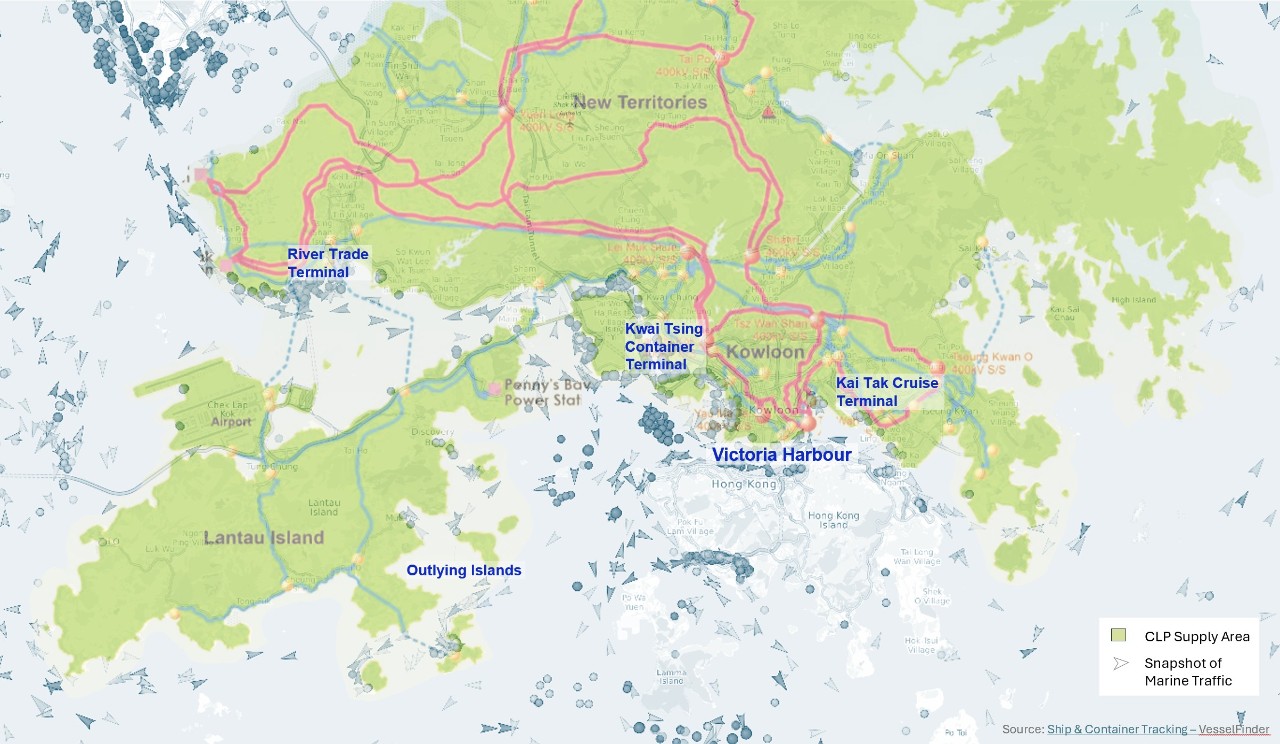
CLP Power facilitates Hong Kong’s marine decarbonisation journey by leveraging its power expertise - delivering cleaner electricity, technical know-how, working with international specialists in marine electric solutions and development to support and enable sustainable port and vessel operations.
Our support includes feasibility studies, power supply planning, technical advisory services, and collaboration with industry partners to pilot new technologies.
We offer a diverse range of power supply solutions tailored to meet the needs of Hong Kong’s evolving maritime sector, including:
Shore Power, E-Vessel Charging and Battery Swapping
Shore Power
E-Vessel Charging
Battery Swapping
Illustrative example: Connecting shore power to a cruise vessel
Illustrative example: Shore power for containerships
The use of Shore Power, also known as Onshore Power Supply (OPS) or cold ironing, is rapidly growing internationally as one of the key decarbonisation pathways.
While low-carbon or clean fuels will provide the main energy source for propulsion for ocean going vessels (OGVs) during transit, vessels at berth still require electricity for a range of essential operations such as crew air conditioning, pump operation, cargo handling equipment etc. Instead of burning vessel fuel, low carbon electricity can be supplied from the shore grid.
In addition to reducing carbon emissions, the use of OPS can significantly reduce pollutants such as sulfur oxides (SOx) and particulate matter (PM) emissions, and modestly reduce nitrogen oxides (NOx) in ports.
The technology can be adopted across different vessel types, including:
OGVs - e.g. liner trade such as containerships and cruise vessels;
River trade vessels (RTVs) - e.g. cargo vessels;
Harbour crafts - e.g. tugs and ferries.
Illustrative example: Quayside charging facility for e-vessels
Electric ferry and its charging facility subsidised under Hong Kong Government-Funded Programme
There has been a growing adoption of hybrid and electric propulsion for vessels to reduce emissions and operating costs. More than 1,000 battery powered vessels have already been delivered globally, marking a significant shift towards cleaner maritime solutions.
To support this transition, well-planned charging facilities and a strategic charging network are essential to enable electric ferries and harbour crafts to charge-up efficiently.
Illustrative example: Battery swapping for cargo ships
Similar to E-Vessel Charging, Battery Swapping offers an alternative by reducing the time required for charging, allowing vessels to achieve quicker turnaround times and maintain operational efficiency.
The technology is particularly suitable for RTVs operating within the region, such as small feeders and cargo vessels.
Based on latest market study, majority of opportunities for marine electrification seen across Hong Kong can be supported by CLP Power’s power grid.
Log inSee moreSee allMenuHomeSearchDid you meanPageHelp and supportDownload our appBusiness objectivesresults foundAccept and continueStart dateEnd dateEvent typeEnviroment relatedPreferred disciplineFirst PreferenceOther PreferenceProject focusProject codeInternship typePagesHelps and supportCourse durationSelect course durationCourse typeforFilter ByClear allShowing {0} of {1} resultsSort byEarliest start dateOldest start dateInternship start dateInternship end datePlease stay tuned for upcoming openings.CalculateKey in the figures and press calculate buttonTotal Carbon emission(kg/COApprox. number of trees plantedElectricity consumption(units)Bill CalculatorBilling Start DateBilling End DateTariff TypeConsumption Unit(kWh)Number of Billing DaysThe earliest date you can select is the 1st day of previous calendar year.Residential TariffConcessionary Tariff for the ElderlyCalculation DetailsNotes:Charge (HK$)DetailsConsumption PeriodRate (HK$)Large Power TariffLarge Power Tariff with High Voltage Super DemandHigh Load Factor Rider DiscountYesNoOn-Peak Period Unit (kWh)Off-Peak Period Unit (kWh)On-Peak Maximum Demand (kVA)Off-Peak Maximum Demand (kVA)Please select datePlease input Consumption UnitThis bill calculator is meant to calculate electricity charges for previous and current years only.The bill calculator can only calculate the budget electricity bill for up to 90 days.Start Date cannot be later than End Date.Please select Tariff TypePlease select High Load FactorPlease input On-Peak Period Unit (kWh) Please input Off-Peak Period Unit (kWh)Please input On-Peak Maximum Demand (kVA)Please input Off-Pear Maximum Demand (kVA)On or off peak demand, whichever is higher, should not less than 35,000 kVAThis topic is related toCustomer Service centreNoteTipView All10 sec videoAs a , I want toResidential customerBusiness customer No data District Sub-districtRecalculatePlease input Number of Billing DaysConsumption UnitkVAkWhEnergy chargeEnergy saving rebateFuel cost adjustmentConcessionary tariffRent & rates special rebateTotal amountEnergy charge on peakEnergy charge off peakDemand charge on peakDemand charge off peak2022 Special rebate2023 Special energy saving rebateSpecial fuel rebateBilling demand shortfallHigh load factor rider discountSearch Help and SupportLatest updateCustomer Service HotlinesYearMonthJanuaryFebruaryMarchAprilMayJuneJulyAugustSeptemberOctoberNovemberDecemberDownloadLink copiedresultsSorry, something went wrong. We can't get that information right now. Please try again later.FeedbackHow would you rate the overall website experience today?Please tell us more(optional)Leave us your comments (optional)SubmitBill CalculatorEV TariffEV Residential Time of Use TariffThe earliest date you can select is {0}.The earliest date you can select is the 1st day of previous calendar year.help-supportApplySortingMost RecentMost RelevantTypeFilesWebpagesSectionBusinessResidentialeMobilityCommunityEnvironmentEducation & developmentHelp & supportFiltersFilteringAll PagesAll Types